
• B-hSEZ6 B16-F10

    NA • 322566

    B-hSEZ6 B16-F10

    Product nameB-hSEZ6 B16-F10
    Catalog number322566
    Strain nameNA
    Strain backgroundC57BL/6J
    NCBI gene ID (Human)
    Chromosome11
    Aliasessez-6; BSRP-C; D11Bhm177e
    TissueSkin
    DiseaseMelanoma

    在此页面上

    • Description
    • Phenotypic analysis
    • Tumorigenicity

    海报

    查看全部

      发表文章

        Description
        • Origin: The B16-F10 cell line is derived from C57BL/6J murine skin cells. The cell line is a commonly used murine model for melanoma.
        • Background Information: Seizure protein 6 homolog is a protein that in humans is encoded by the SEZ6 gene. The protein encoded by this gene is thought to contain five cysteine-rich motifs that are similar to sushi domains, as well as two domains similar to the amino terminal half of the CUB (for complement C1r/C1s, Uegf, Bmp1) domain. Mutations in this gene have been associated with febrile seizures. Aberrant overexpression of SEZ6 has been identified in multiple high-grade neuroendocrine malignancies, including small cell lung cancer (SCLC), high-grade neuroendocrine carcinomas (NECs), medullary thyroid carcinoma (MTC), and central nervous system (CNS) tumors, while exhibiting minimal expression in normal non-neuronal tissues. This tumor-selective expression profile has positioned SEZ6 as an attractive therapeutic target, particularly for antibody-drug conjugate (ADC)-based approaches.
        • Gene targeting strategy: The human SEZ6 coding sequence was inserted into the exon 2 of mouse Sez6 in B-hSEZ6 B16-F10 cells. Human SEZ6 is highly expressed in the B-hSEZ6 B16-F10 cells.
        • Application: B-hSEZ6 B16-F10 cells have the capability to establish tumors in vivo and can be used for efficacy studies.
        Protein Expression Analysis

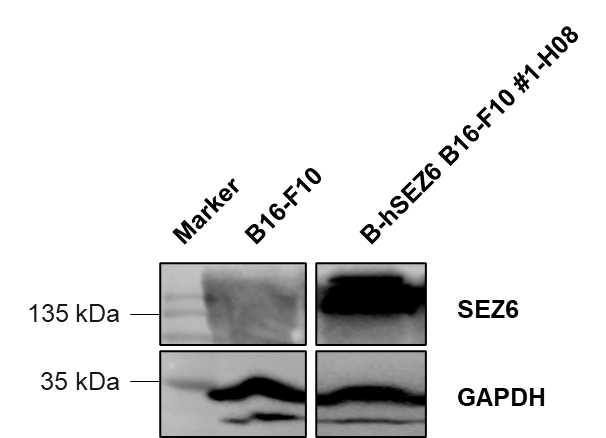
        SEZ6 expression analysis in B-hSEZ6 B16-F10 by western blot. Single cell suspensions from wild-type B16-F10 and B-hSEZ6 B16-F10 cultures were stained with anti-hSEZ6 antibody (Invitrogen, PA5-70720). Human SEZ6 was detected in the B-hSEZ6 B16-F10 cells but not wild-type B16-F10 cells. The 1-H08 clone of B-hSEZ6 B16-F10 cells was used for in vivo experiments.

        Tumor Growth Curve & Body Weight Changes

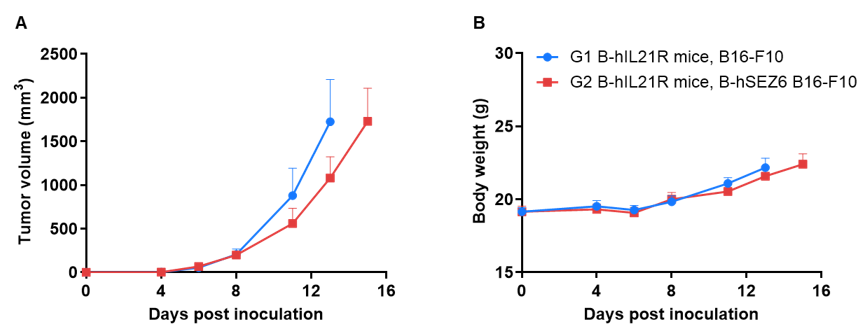
        Subcutaneous tumor growth of B-hSEZ6 B16-F10. B-hSEZ6 B16-F10 (2×10⁵) and wild-type B16-F10 cells (2×10⁵) were subcutaneously implanted into B-hIL21R mice (Female, 8-week-old, n=6). Tumor volume and body weight were measured three times a week. (A) Average tumor volume. (B) Body weight. Volume was expressed in mm3 using the formula: V=0.5 × long diameter × short diameter2. Results indicate that B-hSEZ6 B16-F10 cells were able to establish tumors in vivo and can be used for efficacy studies. Values are expressed as mean ± SEM.
        Protein Expression Analysis of Tumor Tissue

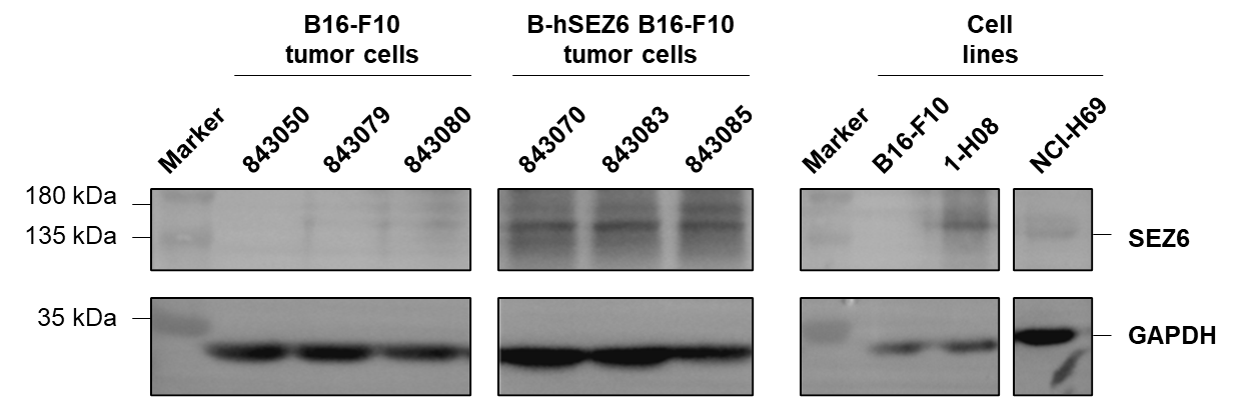
        Human SEZ6 expression evalsuated in B-hSEZ6 B16-F10 tumor cells by western blot. B-hSEZ6 B16-F10 cells were subcutaneously transplanted into B-hIL21R mice (Female, 8-week-old, n=6). At the end of the experiment, tumor cells were harvested and assessed with anti-SEZ6 antibody (abcam, ab314233). Human SEZ6 was expressed on the surface of tumor cells. Therefore, B-hSEZ6 B16-F10 cells can be used for in vivo efficacy studies evalsuating anti-SEZ6 antibodies.

        站点地图