
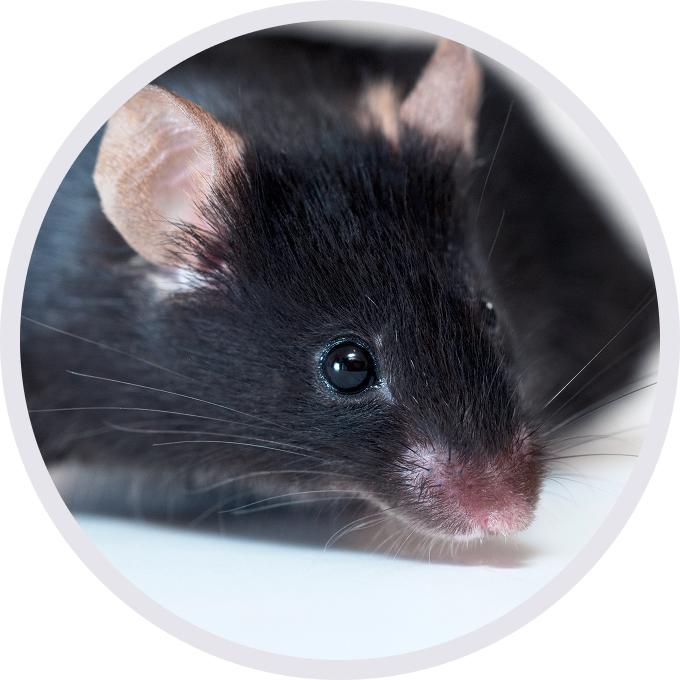
C57BL/6JNifdc-Dmdtm1(Dmd Exon45-50 del)Bcgen /Bcgen • 113915
| Product name | B-Dmd KO(del45-50) mice |
|---|---|
| Catalog number | 113915 |
| Strain name | C57BL/6JNifdc-Dmdtm1(Dmd Exon45-50 del)Bcgen /Bcgen |
| Strain background | C57BL/6JNifdc |
| NCBI gene ID | (Mouse) |
| Aliases | dys; mdx; pke; Dp71; Dp427; DXSmh7; DXSmh9 |


Gene targeting strategy for B-Dmd KO(del45-50) mice. The exons 45-50 of mouse Dmd gene were deleted in B-Dmd KO(del45-50) mice.

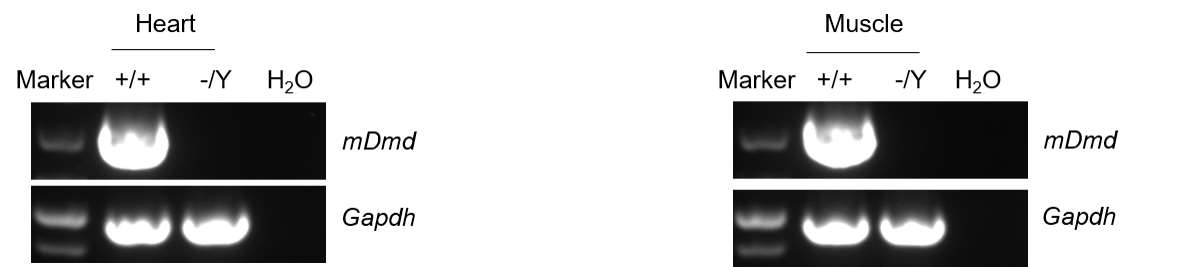
Strain specific analysis of DMD mRNA expression in wild-type C57BL/6JNifdc mice and B-Dmd KO(del45-50) mice by RT-PCR. Heart and skeletal muscle RNA were isolated from wild-type C57BL/6JNifdc mice (+/+) and homozygous B-Dmd KO(del45-50) mice (-/Y), then cDNA libraries were synthesized by reverse transcription, followed by PCR with mouse Dmd primers. Dmd mRNA was detectable in wild-type C57BL/6JNifdc mice (+/+) but not the homozygous B-Dmd KO(del45-50) mice (-/Y).
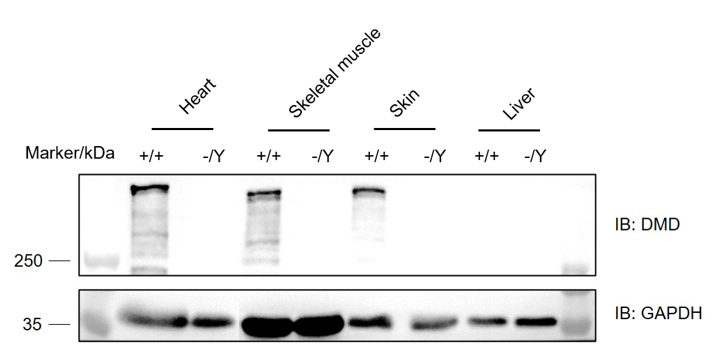
Western blot analysis of DMD protein expression in B-Dmd KO(del45-50) mice. Various tissue lysates were collected from wild-type C57BL/6JNifdc mice (+/+) and B-Dmd KO(del45-50) mice (-/Y), and then analyzed by western blot with anti-Dystrophin antibody (Sigma, D8168). 50 μg total proteins were loaded for western blotting analysis. DMD was detectable in heart, skeletal muscle and skin from wild-type C57BL/6JNifdc mice (+/+) but not homozygous B-Dmd KO(del45-50) mice (-/Y).
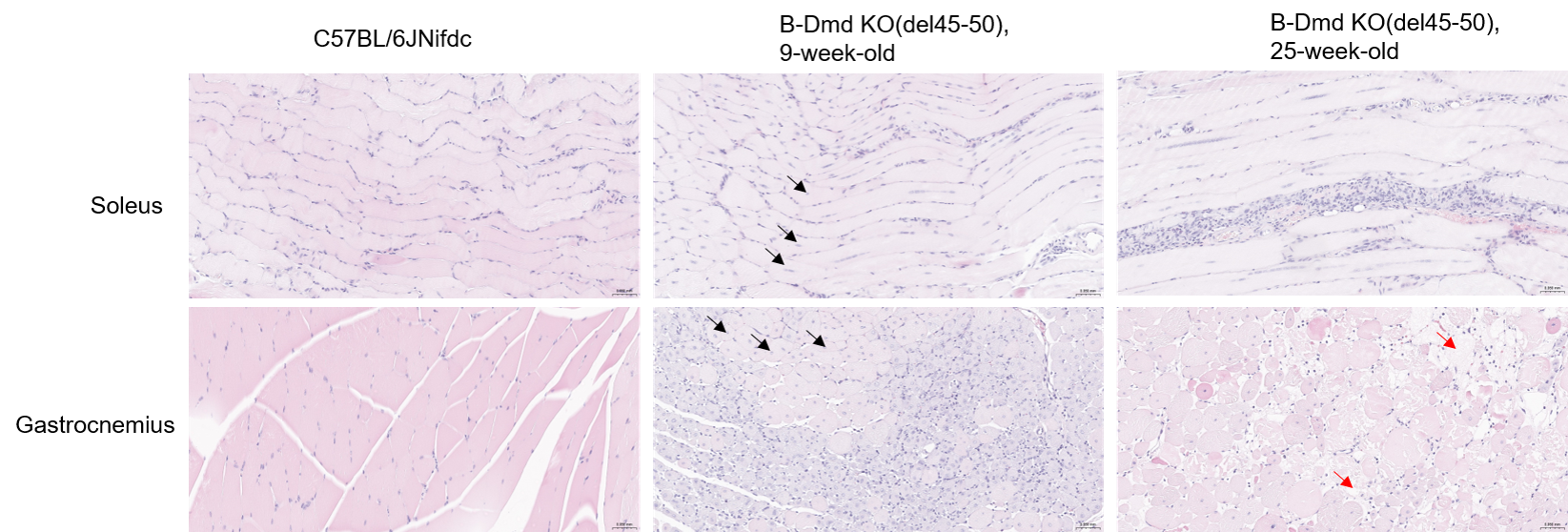
Representative histological images of skeletal muscle from wild-type C57BL/6JNifdc and homozygous B-Dmd KO(del45-50) mice. Gastrocnemius and soleus muscle sections from 9-week-old wild-type C57BL/6JNifdc and homozygous B-Dmd KO(del45-50) mice were presented to display histopathological phenotypes. Gastrocnemius and soleus muscle were stained with hematoxylin and eosin (H&E). Tissue histology was normal in wild-type control mice, but the muscle from homozygous B-Dmd KO(del45-50) mice displayed centrally-located nuclei (black arrow), inflammatory cell infiltration and muscular atrophy. Myofiber necrosis (red arrow) was also observed in 25-week-old B-Dmd KO(del45-50) mice. All those abnormalities were more pronounced in the gastrocnemius muscle in homozygous B-Dmd KO(del45-50) mice.
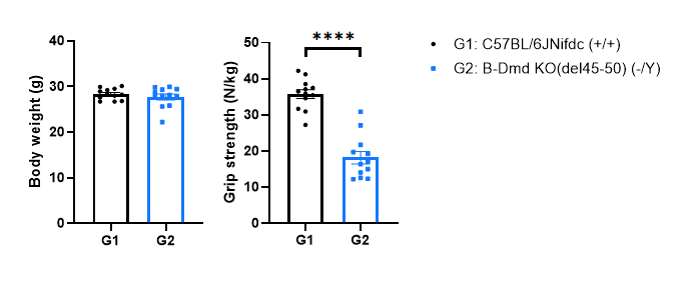
Behavioral performance in wild-type C57BL/6JNifdc and homozygous B-Dmd KO(del45-50) mice. Grip strength tests were conducted to assay the behavioral performance in wild-type C57BL/6JNifdc and homozygous B-Dmd KO(del45-50) mice (male, 3-month-old, n=12). Grip strength results showed the strength produced by forelimb was ~18 N/kg in homozygous B-Dmd KO(del45-50) mice, which was significant weaker than that in wild-type control mice. All grip strength measurements are normalized to the individual animal’s body weight. Values are expressed as mean ± SEM. Significance was determined by unpaired t test. *P < 0.05, **P < 0.01, ***P < 0.001, ****P < 0.0001.
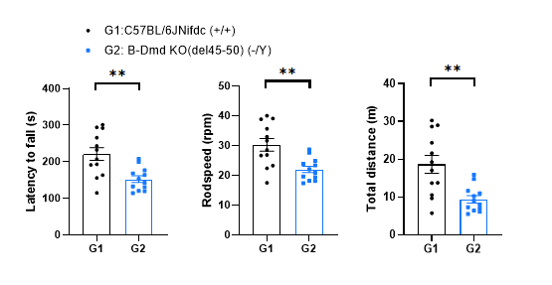
Behavioral performance in wild-type C57BL/6JNifdc and homozygous B-Dmd KO(del45-50) mice. Rotarod tests were conducted to assay the behavioral performance in wild-type C57BL/6JNifdc and homozygous B-Dmd KO(del45-50) mice (male, 3-month-old, n=12). Rotarod tests were performed to assay the motor coordination. The latency to fall, rodspeed and total distance were significantly decreased in homozygous B-Dmd KO(del45-50) mice, showing the impairment of motor coordination and balance. Values are expressed as mean ± SEM. Significance was determined by unpaired t test. *P < 0.05, **P < 0.01, ***P < 0.001, ****P < 0.0001.
